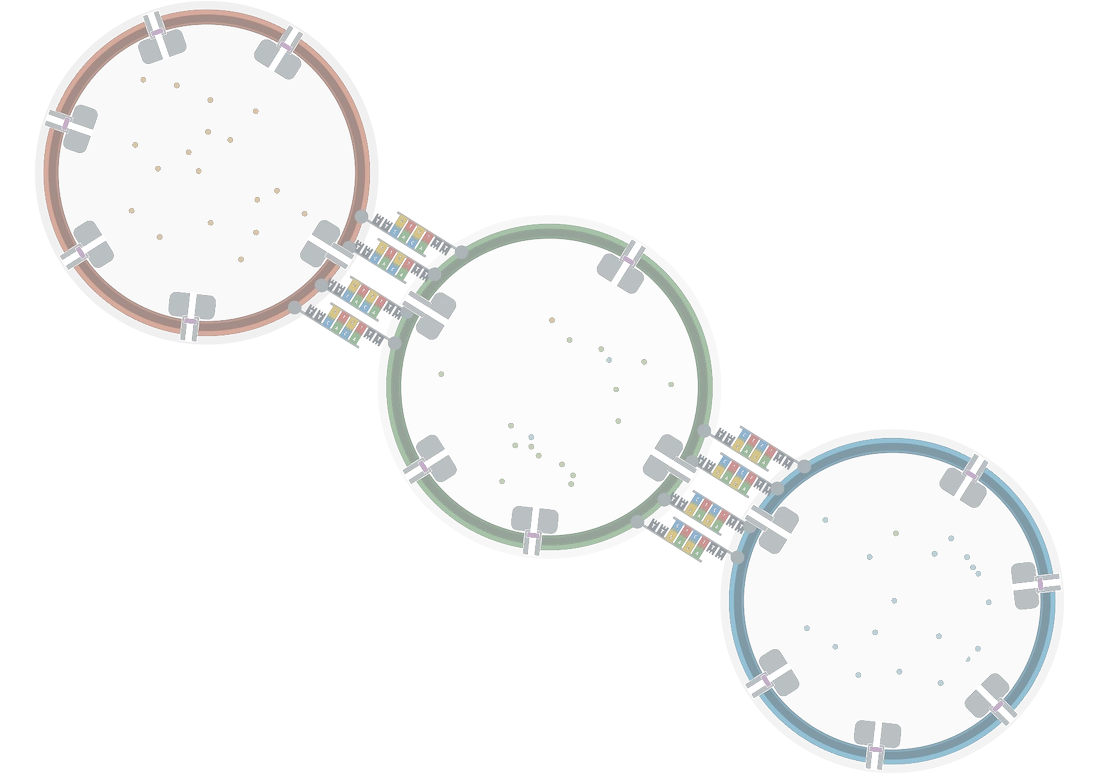
Bond lifetime
Very short-lived bonds produced mostly monomers, whereas longer-lived bonds allowed persistent GUV connections.
ALiGN aims to build a network in which GUVs connect to selected partners and exchange their contents through those connections. Understanding how DNA-mediated binding influences GUV aggregation is therefore essential for controlling the formation of this network.
We developed a three-dimensional Brownian dynamics model to investigate how DNA surface density and DNA bond lifetime affect GUV aggregation. The model incorporates GUV diffusion, contact-dependent DNA bridge formation, membrane recruitment of DNA linkers, and bond dissociation, and tracks the numbers of GUVs belonging to monomers, dimers, and multimers over time. The simulation demonstrated that DNA surface density and bond lifetime are key parameters for controlling GUV aggregation. By tuning these parameters, the balance among monomers, dimers, and multimers could be changed.
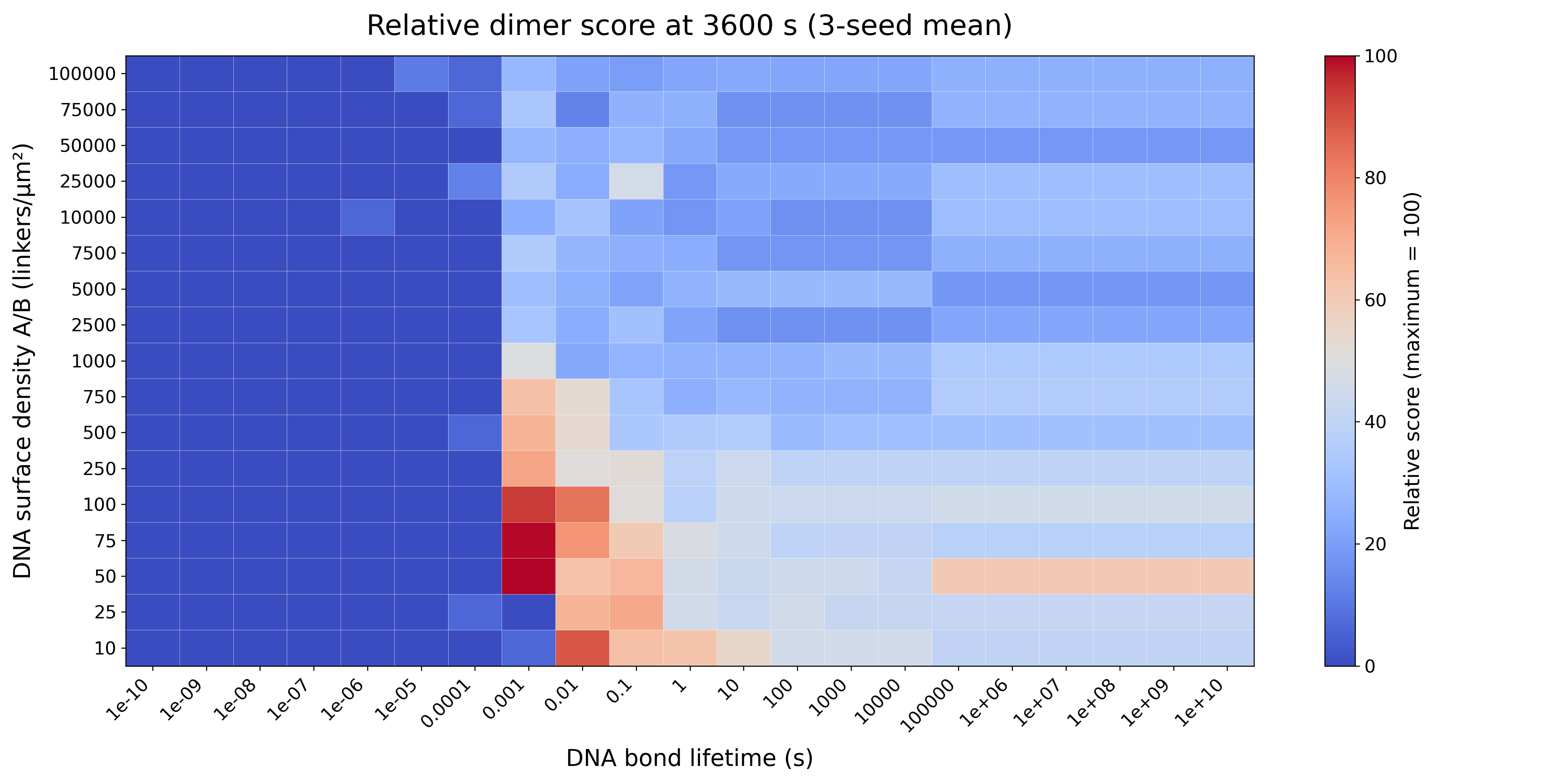
Very short-lived bonds produced mostly monomers, whereas longer-lived bonds allowed persistent GUV connections.
Low density limited aggregation, while high density promoted the formation of larger multimeric clusters.
Among the evaluated conditions, a DNA surface density of 50 linkers/µm² on both GUV types and a bond lifetime of 0.001 s achieved the highest score at 3,600 s for promoting dimer formation while limiting multimer formation. This comparison used the average of three random-seed runs.
This model simulates the motion and aggregation of two types of equally sized GUVs in three dimensions. It combines Brownian motion, DNA-mediated binding and dissociation, and the recruitment of membrane-bound DNA into contact regions. The numbers of monomers, dimers and larger clusters are tracked over time to examine how DNA surface density and DNA bond lifetime affect aggregation.
The flowchart below summarizes the simulation procedure, followed by a brief explanation of each step.
Sij is the contact area between GUVs i and j (µm²), R is the common GUV radius (µm), dl is the DNA reach (µm), and rij is the centre-to-centre distance (µm). The max function sets the contact area to zero when the GUVs are too far apart.
Adapted from Eq. (1) of Sánchez et al. [1]. The adaptive time step follows the force-stability, contact-resolution and probability limits, and stops at the next recording time.
Poff,ij is the probability that the entire connection between GUVs i and j dissociates during one time step, Δt is the time-step width (s), τoff is the specified DNA bond lifetime (s), and Bij is the effective number of DNA bridges connecting the pair.
This whole-pair release rule is an assumption of the present model, including its extension to non-integer bridge counts. Sánchez et al. instead assume permanent bonding after the first stable bridge [1].
A bonded pair dissociates when a uniform random number u ∈ [0, 1) is smaller than Poff,ij. Dissociation removes the entire pair connection and returns its allocated DNA to both GUVs; individual partial breakage is not tracked.
Δqij is the number of additional DNA linkers recruited to contact ij during one step, mij is the remaining recruitable amount limited by free DNA and contact capacity, Δt is the time-step width (s), and τl,ij is the characteristic membrane-diffusion and trapping time for that contact (s).
This is Eq. (4) of Sánchez et al. [1], rewritten using the contact area. They attribute the empirical trapping-time relation to Chao et al. [2].
Recruitment is evaluated for surviving contacts with positive area. After recruitment, Bij is updated from the effective bridge count qij. A shrinking contact area limits further recruitment but does not remove existing bridges.
Pon,ij is the probability of forming the first bridge during one time step, Nfree,i and Nfree,j are the unallocated DNA counts on the two GUVs, Sij is their contact area (µm²), 4πR² is the surface area of one GUV (µm²), Δt is the time-step width (s), and τh is the hybridization-time parameter (s). The min function makes the GUV with fewer available linkers the limiting side.
Following Eq. (2) of Sánchez et al. [1], with their low-coverage approximation of the available surface as 4πR².
For an eligible unbound A–B pair, a new bridge forms if a fresh uniform random number u ∈ [0, 1) is smaller than Pon,ij. Each GUV must have at least one free linker, and the contact capacity must be at least one. A pair that dissociated in this step cannot rebind in the same step.
xi(t) is the position of GUV i at time t (µm), Di is its diffusion coefficient (µm²/s), fi = Fi/(kBT) is the reduced force (µm⁻¹), Δt is the time-step width (s), and ξi is a three-dimensional standard normal random vector.
The repulsive interaction uses the WCA form [3], while bonded pairs are held by a FENE interaction [4] based on the model of Sánchez et al. [1].
This implementation uses an overdamped Brownian position update, and periodic wrapping is applied after movement.
We compared GUV aggregation at 3,600 s across combinations of DNA surface density and bond lifetime. The heatmap shows bond lifetime on the horizontal axis, surface density on the vertical axis, and a relative score combining dimer abundance with selectivity over multimers.
D and M are the numbers of GUVs belonging to dimers and multimers, respectively; N is the total number of GUVs. The score is zero when D + M = 0. Smax is the maximum score among the evaluated conditions.
The heatmap shows that the favorable aggregation outcome depends on the combination of DNA surface density and bond lifetime, revealing an optimal region in this parameter space. Among the evaluated conditions, DNA surface density 50 linkers/µm² and bond lifetime 0.001 s gave the highest score at 3,600 s. This three-seed averaged result identifies the best condition under the stated evaluation criterion.
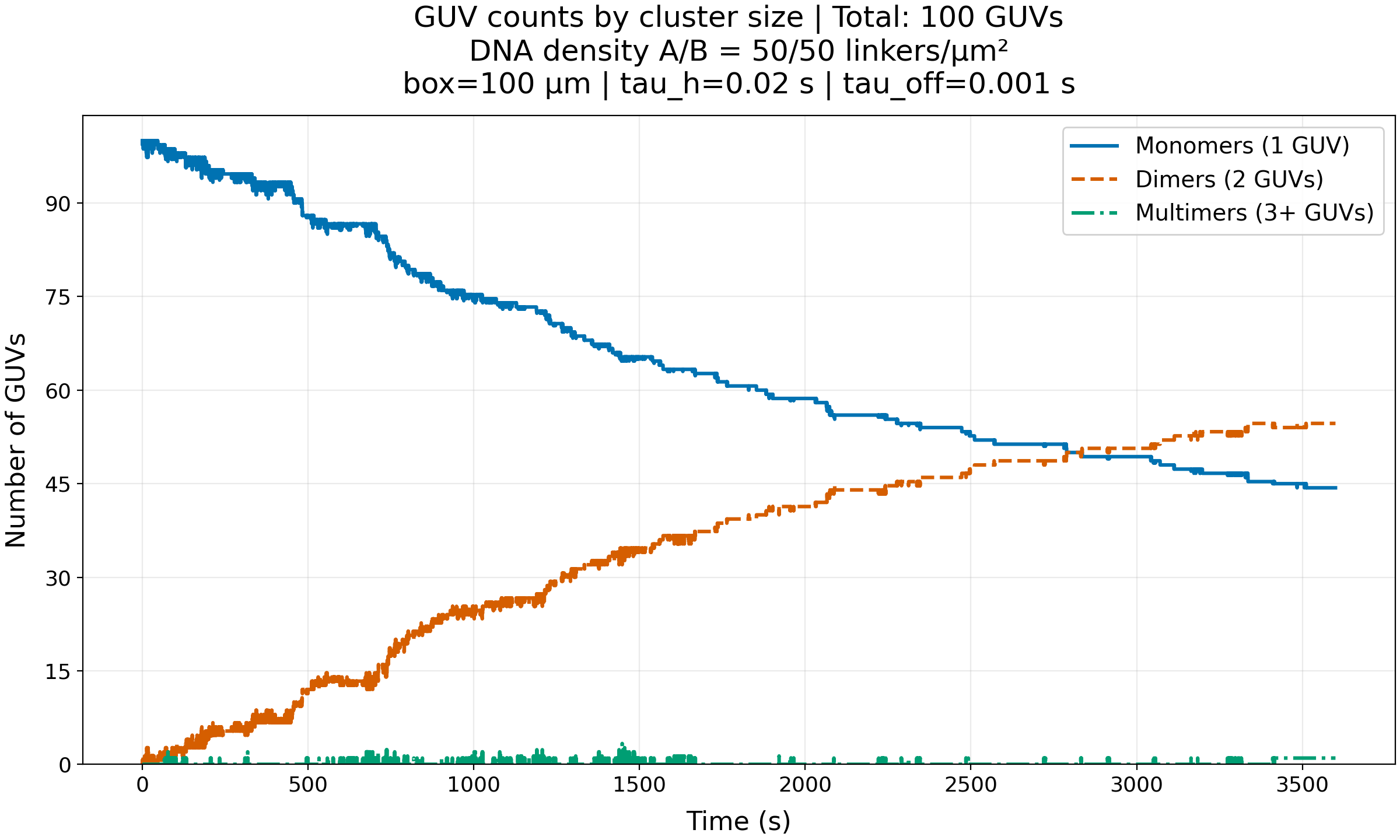
The horizontal axis shows time in seconds and the vertical axis shows the number of GUVs in each cluster category. Blue, orange, and green indicate monomers, dimers, and multimers (three or more GUVs), respectively. Each dimer contributes two GUVs to the orange curve.
The curves show the pointwise average of three independent random-seed runs. At 3,600 s, the integer-displayed average was 44 monomer GUVs, 55 GUVs belonging to dimers, and 1 GUV belonging to a multimer (3+ GUVs). The orange value counts GUVs, so a dimer pair contributes two. In each individual run, the number of GUVs in dimers is therefore even. The value 55 is the three-seed average rounded to a whole GUV; it does not represent 55 GUVs in dimers in a single run.
Figures 3–5 show individual runs for Seed 42, Seed 126, and Seed 210 at a DNA surface density of 50 linkers/µm² and a bond lifetime of 0.001 s. These plots show the variation between runs under the same conditions.
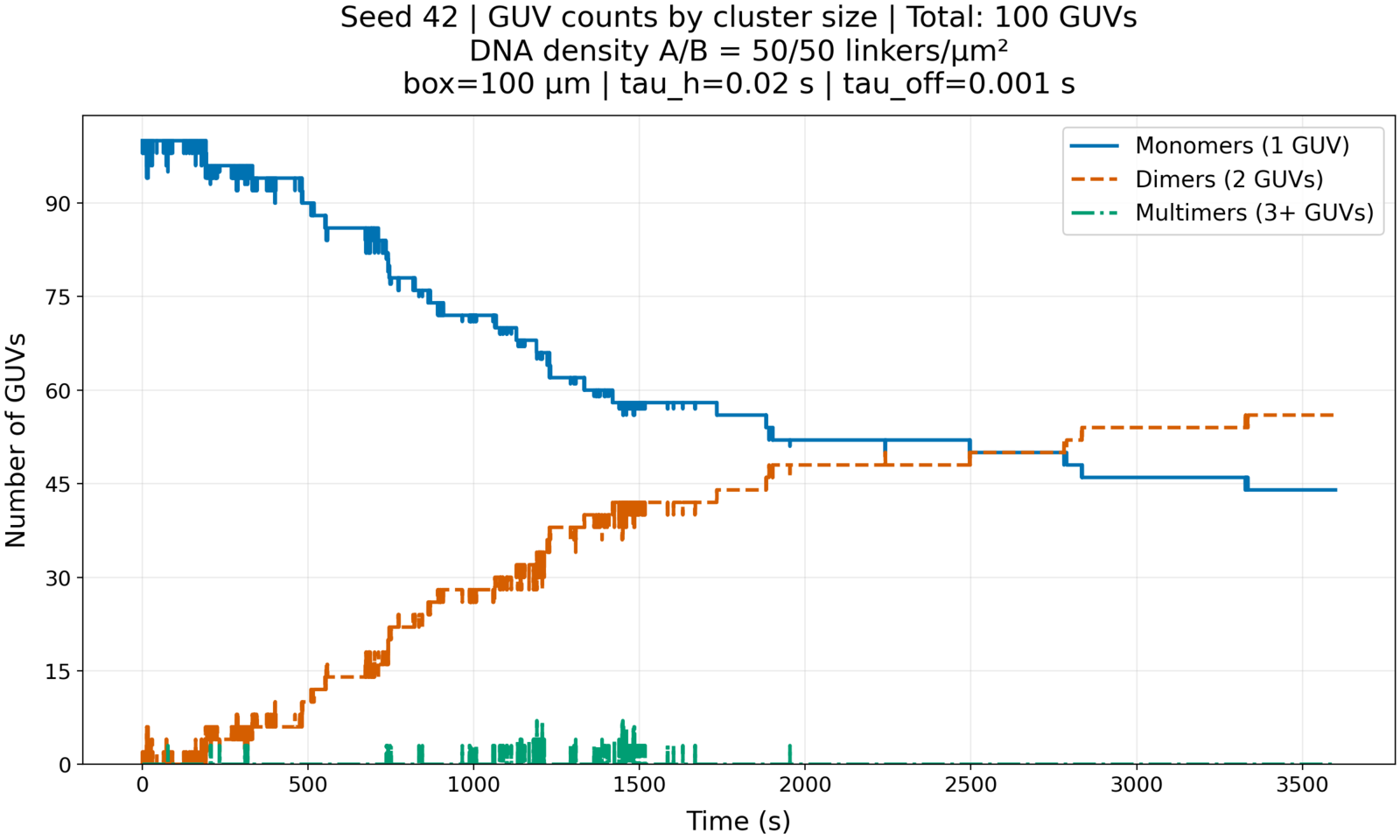
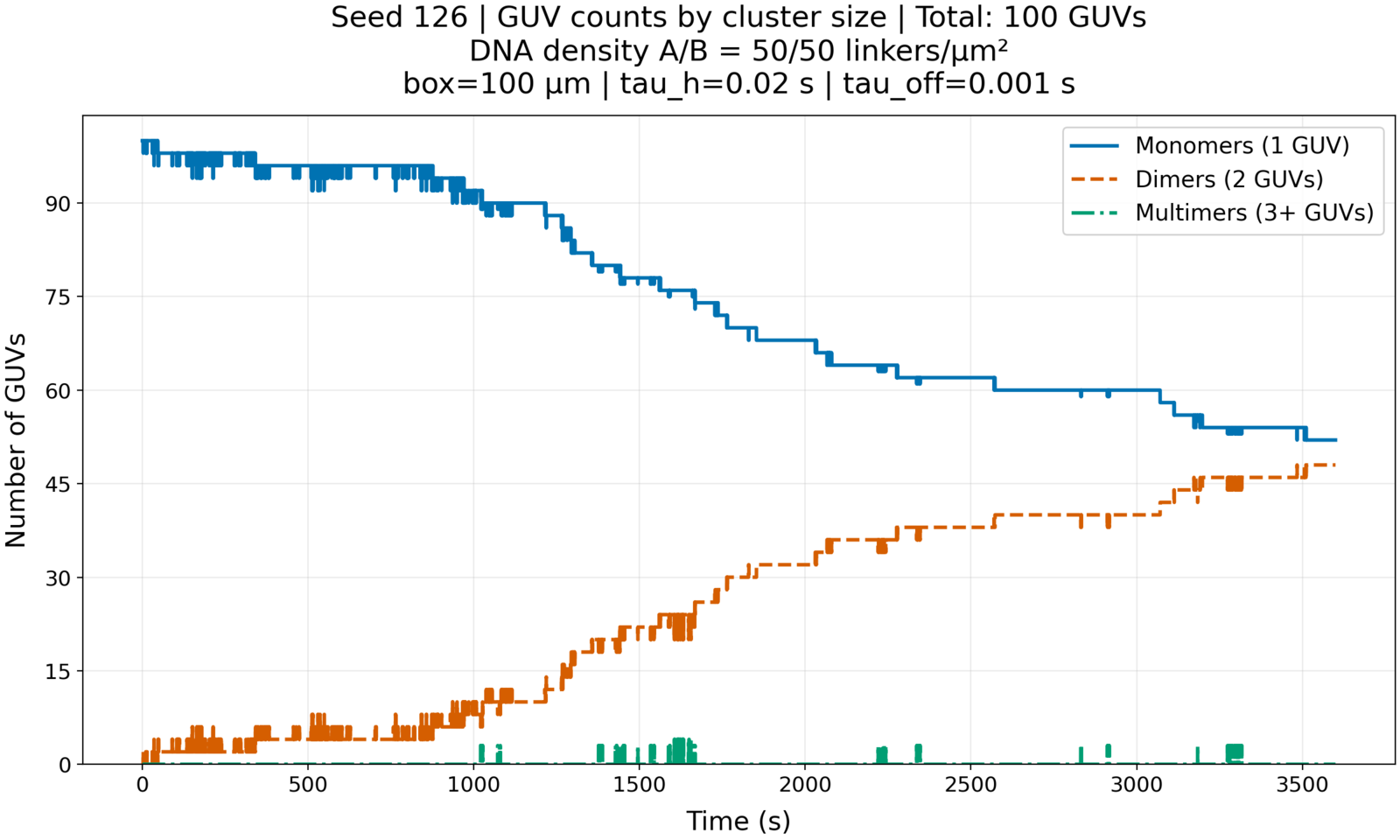
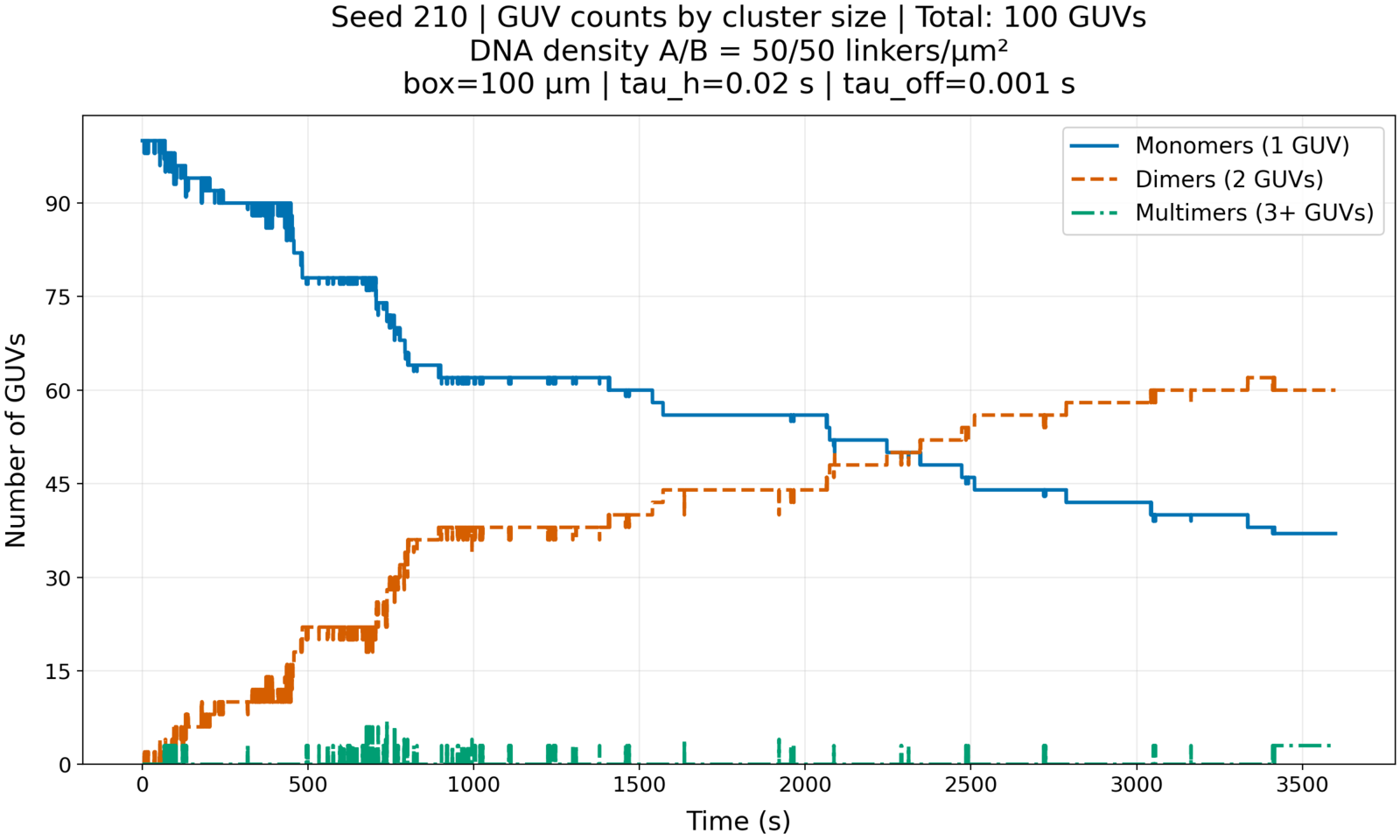
Across all three random seeds (42, 126, and 210), the final number of GUVs belonging to dimers exceeded that belonging to multimers. This consistent trend indicates that, in this simulation, a DNA surface density of 50 linkers/µm² and a bond lifetime of 0.001 s favor dimer formation while limiting multimer formation.
The comparison across conditions demonstrates that DNA surface density and bond lifetime are key parameters controlling GUV aggregation. Tuning these parameters changes the balance between dimer and multimer formation.
At the selected best condition, the three-seed averaged endpoint contained 55 GUVs in dimers, compared with 1 GUV in multimers and 44 monomers. This result shows that DNA surface density and bond lifetime can be tuned together to favor dimer formation while limiting larger clusters. These results support the ALiGN design strategy of controlling connectivity through DNA surface density and bond lifetime.
[1] Sánchez, P. A., Caciagli, A., Kantorovich, S. S. & Eiser, E. Kinetically limited valence of colloidal particles with surface mobile DNA linkers. J. Mol. Liq. 382, 121895 (2023). https://doi.org/10.1016/j.molliq.2023.121895 ↩ Back to the text
[2] Chao, N.-M., Young, S. H. & Poo, M.-M. Localization of cell membrane components by surface diffusion into a “trap”. Biophys. J. 36, 139–153 (1981). https://doi.org/10.1016/S0006-3495(81)84721-2 ↩ Back to the text
[3] Weeks, J. D., Chandler, D. & Andersen, H. C. Role of repulsive forces in determining the equilibrium structure of simple liquids. J. Chem. Phys. 54, 5237–5247 (1971). https://doi.org/10.1063/1.1674820 ↩ Back to the text
[4] Grest, G. S. & Kremer, K. Molecular dynamics simulation for polymers in the presence of a heat bath. Phys. Rev. A 33, 3628–3631 (1986). https://doi.org/10.1103/PhysRevA.33.3628 ↩ Back to the text