ELSI
Ethical Issues
Artificial Cells and the Definition of Life
Life is generally considered to have various characteristics, such as metabolism, maintenance of homeostasis, self-reproduction, and response to the environment [1][2]. However, the definition of life is still debated, and there is no unified view on which functions an entity must have to be regarded as alive.
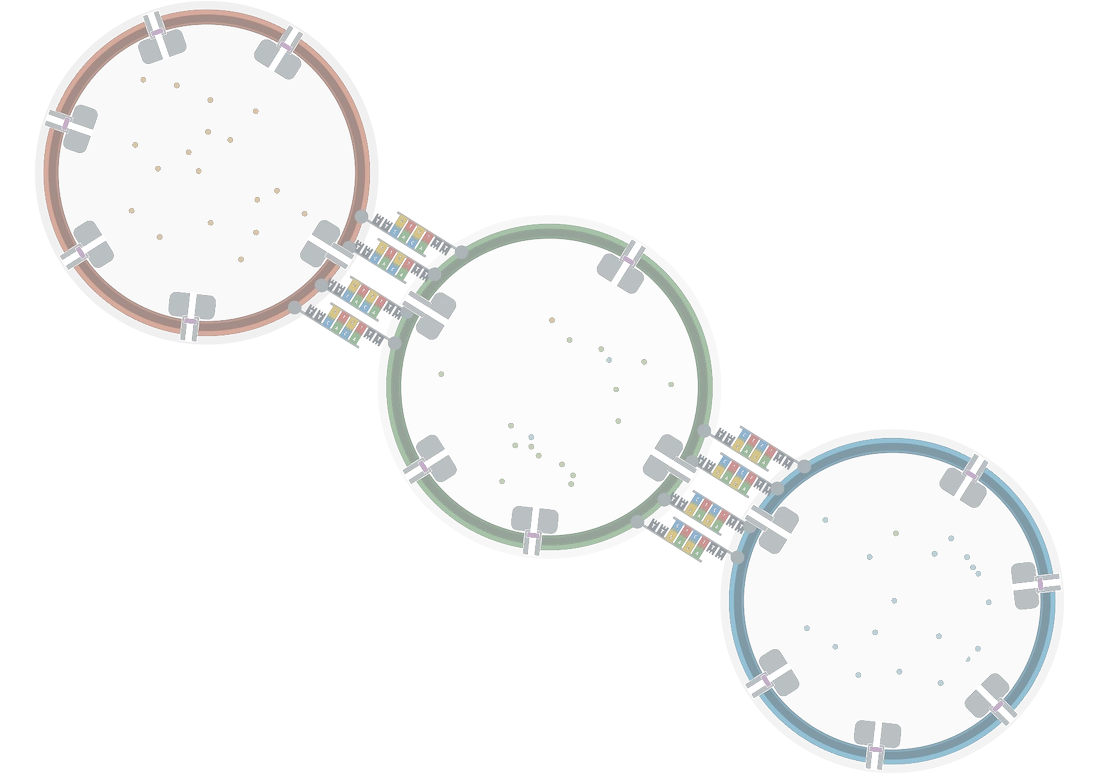
ALiGN aims to build a network of GUVs, which are made of lipid bilayers. In this network, DNA enables selective connections between GUVs, while α-hemolysin and TRIMEB enable the exchange of contents between connected GUVs. This builds an artificial analogue of a part of cell-to-cell communication.
However, even if GUVs are selectively connected and can exchange contents, this alone does not make them alive. The GUVs used in this project imitate a part of cell-to-cell communication, but they do not autonomously have the functions seen in living things, such as metabolism, maintenance of homeostasis, and self-reproduction.
On the other hand, if networks of artificial cells become more complex through future research and acquire functions similar to those of living things, an ethical question may arise: at which stage should they be treated as living?
Therefore, the functions of artificial cells should be clearly distinguished from the functions of living things in nature, and the definition of life and the handling of artificial cell networks should continue to be discussed from scientific and ethical perspectives as the technology develops.
Legal Issues
Biosafety of Toxin-Derived Proteins
In this project, we use α-hemolysin to form pores in the lipid bilayer of GUVs and to enable the exchange of materials. α-hemolysin is a pore-forming toxin produced by Staphylococcus aureus, and it damages cells by forming pores in their membranes. It has also been reported to cause cell death and inflammatory responses and to contribute to infections caused by S. aureus [3]. Therefore, when we use α-hemolysin in research, we need appropriate safety management that takes its effects on the human body and the surrounding environment into account.
In addition, we use genetically modified Escherichia coli to purify α-hemolysin. When genetically modified E. coli are used in a laboratory, containment measures suited to the experiment must be taken in accordance with the Cartagena Act, the Japanese law that regulates the use of living modified organisms.
Therefore, it is important not only to consider the usefulness of α-hemolysin, but also to understand correctly its toxicity and the potential risks of genetic recombination technology, and to handle it appropriately in compliance with the relevant laws and the safety regulations of our institution.
Social Issues
Understanding and Acceptance of Technology
Artificial cells and DNA nanotechnology are expected to be applied to the elucidation of life phenomena and to medicine, but they are not necessarily well understood by the general public.
In this project, we aim to imitate cell-to-cell communication by using DNA to control which GUVs connect to each other and how many connections each GUV makes. However, the GUVs we use, unlike cells in nature, do not have autonomous functions of life. In addition, the DNA that connects the GUVs is not intended for genetic modification; we use it to connect GUVs selectively.
On the other hand, the words “artificial cell” and “DNA manipulation” may remind people of the creation of artificial life or of genetic modification, and may cause ethical concerns and psychological resistance.
Therefore, to promote social understanding, we need to communicate not only our research purpose, the mechanism of the technology and its expected applications, but also its current technical limitations and potential risks, based on scientific evidence and through dialogue with society.
Future Actions and Proposals
- Continuing to examine, through scientific discussion, the ethical issues of artificial cells and the definition of life.
- Managing α-hemolysin and genetically modified E. coli safely, and complying with the Cartagena Act and other relevant laws.
- Maintaining transparency about research results, technical limitations and potential risks, while promoting both the protection of intellectual property and the sharing of technology.
- Promoting understanding of and trust in artificial cell technology through education, outreach and dialogue with society.
References for the ELSI
[1] NASA Science. How can we tell if something is alive or not? (Astrobiology Learning Progressions, 3.5). https://science.nasa.gov/astrobiology/learning-resources/alp/alive-or-not/ ↩ Back to the text
[2] OpenStax. Biology 2e, Section 1.2. https://openstax.org/details/books/biology-2e ↩ Back to the text
[3] Tam, K. & Torres, V. J. Staphylococcus aureus secreted toxins and extracellular enzymes. Microbiol. Spectr. 7, GPP3-0039-2018 (2019). https://doi.org/10.1128/microbiolspec.GPP3-0039-2018 ↩ Back to the text